


Healthy lifestyle
A healthy lifestyle is one which helps to keep and improve people's health and well-being.Many governments and non-governmental organizations have made big efforts in healthy lifestyle and health promotion.

Mental Health
Mental health can be considered a very important factor of physical health for the effects it produces on bodily functions. This type of health concerns emotional and cognitive well-being or an absence of mental disorder.

Public health
Public health can be defined in a variety of ways. It can be presented as "the study of the physical, psychosocial and socio-cultural determinants of population health and actions to improve the health of the population.

Reproductive Health
For the UN, reproductive health is a right, like other human rights. This recent concept evokes the good transmission of the genetic heritage from one generation to the next.

Health
Health is a state of complete physical, mental and social well-being, and not merely the absence of disease or infirmity.
samedi 4 août 2018
Looking For a Therapist? Here's Everything You Need to Know About Finding the Right One

Finding a mental health provider can be difficult, but certainly not impossible. Emotional well-being is a sensitive topic; however, it's one that affects many. In fact, approximately one in five adults in the US - that's 43.8 million people - experiences mental illness in a given year, and only 41 percent of adults in the US with a mental health condition received care in the past year, according to a 2015 survey.
With the current discussion of mental health after the tragic losses of Kate Spade and Anthony Bourdain, breaking the stigma and helping those with mental health issues seek help is being brought to the spotlight. Every person experiences adversity and challenges at some point in their life, and sometimes having the support of a mental health provider can be helpful if not critical to overcoming it.
Finding a provider that is aligned with your personal needs can take time. It is important that you stay the course to find someone who is a good personality match for you, and after a few sessions, if you decide it's not a fit, it's OK to try someone new.
Below are some tips to help guide you in your search for a therapist:
Ask Friends and Family You Trust For Recommendations
Due to conflict, most therapists won't see you as a patient if they see your family or friends. However, therapists often have close-knit circles of other professionals that they can use for referral networks. Your primary care physician (PCP) can also be a resource for you to find a mental health provider. If you have a good relationship with your doctor, see if they can help you get started with a referral. Getting a recommendation is like an inside scoop on finding someone great to help you.
You're Special, So Pick a Specialist
While this doesn't apply to everyone looking to speak with a therapist, if you have been previously diagnosed with certain disorders such as generalized anxiety disorder (GAD), major depressive disorder (MDD), obsessive compulsive disorder (OCD), attention deficit hyperactivity disorder (ADHD), addiction, an eating disorder, or another diagnosis, it's important to find someone who specializes in treating that condition. Look at mental health provider profiles to check if their specialties align with your diagnosis.
Google, but Don't WebMD It
The internet is a great place to do your research to find a mental health provider. Whether using sites to find someone in your neighborhood who takes your insurance, reading provider profiles, or seeing reviews, having resources is always great. Searching for providers can help you get a sense of that person from their reviews and experience. However, do be mindful that one bad review shouldn't deter you from having a phone call - we all want something different out of mental support, and you may like that person.
A Strong Résumé Does Not Always Equal Relationship-Worthy
While most will tell you the credentials for a provider are key, sometimes you just need to click with a person. Of course you want a therapist who is licensed and completed an accredited specialty program for their area of expertise. However, what looks good on paper - e.g., Ivy League grad - doesn't always equate to a match for your personality. Use your intuition to discern whether your temperament aligns with the therapist's approach and demeanor. Simply stated, trust your gut!
Date Around
Before you book an appointment with a therapist, have a phone date. Interview them to get a sense of their style and talking approach. A phone call beforehand can give you a sense of the therapist and their thought process and will let them get to know you a bit.
Here are some good questions to ask:
- What is their approach to therapy (e.g., do they follow a psychiatry or psychology "school of thought")?
- Ask what a session would be like. Do they let you just talk? Do they give advice? Do they focus on why or what is causing you to feel a particular way?
- Do they have experience working with the mental health issue you're encountering? (You can explain if you've just been feeling sad, overly stressed, having relationship issues, etc.)
- What can you expect as far as your emotional well-being progress is concerned? (Note: there are many types of therapist and mental health providers - it's good to familiarize yourself with those and think about what most closely aligns with your goals.)
The First Date
Once you've found a person that you like and have an initial first phone call, you'll have your first session with them. During the first meeting, similar to a first date, the therapist or provider will have what they call an intake session. You will be asked about your background, provide medical history, and explain why you have chosen to look for a mental health provider. Sometimes intake can take one to two sessions - be patient. Having this information will only be helpful down the line. Just as you want to get to know a person on the first few dates before you decide if you want to keep seeing them, the same goes with a therapist. Don't expect the first session to be a place to fully unload everything you need to get off your chest.
Explore Other Options
Lastly, if you are unsure whether a one-on-one style works for you, support groups are a great place to look. Find a support group that focuses on what you are experiencing. For example, if you are dealing with a loss, look for a support group that deals with loss of a loved one. This will be a great place to share what you are experiencing but also be around a group of people who can truly understand what you are going through.
In addition to seeking out a mental health professional, here are some apps to have at your fingertips to help manage your day to day.
- Headspace: Combining science and meditation, Headspace offers research-based meditation journeys to help address anxiety, stress, and overall mental health. The app provides guided meditation for beginners to novices.
- Calm: Similar to Headspace, Calm is a meditation app that provides various tracks of guided meditation to focus on the now. Mindfulness is the goal to help users breathe through the tough times using tools learned in each session.
- Pacifica: A combination of Headspace and a journaling tool, Pacifica provides guided meditation tracks based on your goals, provides a place for you to journal and track your progress, and even allows you to connect with your mental health provider for a holistic perspective on your journey.
Your journey to overcoming the stresses in your life and addressing your mental health needs doesn't need to be a lonely one. Start your path to finding a provider today.

A Golden Girls Cookbook Is Happening, and We're Already Hooked on the Cheesecake Recipe

The only thing that might be better than cooking with Sophia, Blanche, Dorothy, and Rose is cooking recipes inspired by Golden Girls while the show plays in the background. That will be a possibility soon enough, because a Golden Girls cookbook is coming out in 2020! The book, set to be published by Kingswell, an imprint of Disney Publishing, will be full of recipes inspired by the timeless sitcom, according to Babble.
Few additional details are known yet, but it wouldn't be a culinary ode to Golden Girls without at least one cheesecake recipe, would it? Babble has released the book's recipe for Double Fudge Chocolate Cheesecake, and yep, this cookbook is going to be legit. Just like the girls used to do, we see many round-the-cheesecake chats happening in our futures, too.
These Wines by the Glass Are Small Enough to Stash in Your Purse - and They're So Chic!

It's a common dilemma: you want to open a new bottle of wine, but you only plan on drinking a glass or two. Some wine experts say it's best to finish the whole bottle within 24 hours for the freshest taste, and it's a bummer to pour another glass the following week only to realize it's gone bad. A solution that's becoming more common is the idea of letting people buy wines by the glass - in places other than restaurants. And a new company called Standard Wines, which launched in November, makes this concept more accessible to wine-lovers everywhere.
From the founders of Vinebox, the wines-by-the-glass subscription service, Standard offers a red, white, and Rosé wine, each made in California and packaged in a 187-milliliter bottle that's, might I add, quite chic. Each bottle (aka glass) translates to one 6.3-ounce pour and costs $8. Right now, Standard Wines are available to order online (starting in packs of six).
"As options for alternative formats increase, it seems the median level of quality is dropping in correlation. It's our mission to remove the compromise associated with smaller formats and deliver generous, quality wines to everyone in an easy-to-enjoy, noncommittal, single-serving size," the company said in a press release. If you're into the idea of reaching for a one-and-done glass of wine whenever you feel like it (and not worrying about finding a bottle stopper when you're done), keep reading to learn more about this new company's offerings before you see them in stores.
20 Freezer Meals For Back to School and Beyond

When you're on the go, it's incredibly convenient to have meals that are fully prepared in the freezer. Just pop these dishes in the oven until they're nice and hot and enjoy a home-cooked meal whenever you want. Here are 20 fast and easy ideas that also happen to freeze very well.
Oreo's State Fair Cookies Are Out Now, So Make Some Room in Your Freezer (and Stomach)

Deep-fried Oreos are a state fair staple, and now you don't even have to go to a fair to get your hands on one. Oreo has released its own version of the classic treat: State Fair Oreos available in Vanilla Crunch and Chocolate Crunch. Unlike regular Oreos found in the snack aisle, these can be found in the freezer section of the grocery store - exclusively at Walmart, to be exact. To enjoy them, you simply heat them up in the oven for five minutes (for maximum crunch) or in the microwave for 30 seconds (for a quick fix). Oreo is making things way too easy on us!
This over-the-top treat features a classic Oreo cookie in the middle surrounded by a crunchy coating, which is either vanilla- or chocolate-flavored. Once heated, the dessert is creamy on the inside and crispy on the outside. Are you drooling yet? Prepare to make some room in your freezer and pick these up if you spot them at Walmart.
I'm Pansexual, and Here's What I Want You to Know

The first time I came out to my parents was in 2013. I was 15 at the time, but I still remember it clear as day. I wrote my mom and dad letters, put them each into an envelope, and handed them off. I knew I would be a mess of tears if I tried to come out to them face to face, so I figured I could gather all of my thoughts more concisely into a letter. I don't think either of them were quite shocked because I was always a little different, but nonetheless, they told me they were proud of me and wouldn't trade me for the world.
I'd always assumed I was a lesbian because I was attracted to women and had only ever dated a girl before. I was confused and felt the weight of society falling on my shoulders. I was 15 and liked women, but there was still this nagging feeling that maybe I wasn't just a lesbian.
I knew I liked women, and I knew I'd had feelings for men, but I wasn't quite sure that I was bisexual.
I never knew that I could be anything more than a lesbian, so I continued to identify that way. It wasn't until last year that I sparked a conversation with my roommate about sexuality. I was taking a queer studies class, and for the first time since 2013, I stopped and looked my sexuality dead in the face. And I was truly stumped. I knew I liked women, and I knew I'd had feelings for men, but I wasn't quite sure that I was bisexual. My feelings felt stronger than that.
It wasn't until I did some necessary Google searching that I came across a list of sexual orientations. I scrolled through terms I knew, and ones I'd never heard of, until I finally landed on pansexual. Something just seemed to fall into place. There was finally a word to explain how I'd been feeling.
So, what exactly is pansexuality?
This is a perfect starting point for something so complicated to explain. The thing is, you can look up a definition with a click of button, but in the end, you'll find that pansexuality as a whole is very different from person to person. As Merriam-Webster puts it, "Pansexuality is of, relating to, or characterized by sexual desire or attraction that is not limited to people of a particular gender identity or sexual orientation," but what I really like to tell people is that pansexuality is fluid and encompasses all people, regardless of their gender identity.
One of the many things I love about being pansexual is that my love for human beings has no bounds. There are no restraints telling my heart that I can't love a person because of their gender identity. When it comes to attraction, I look for a connection as opposed to a gender, which really opens up a whole new world of relationships.
When it comes to attraction, I look for a connection as opposed to a gender, which really opens up a whole new world of relationships.
A common misconception people have about pansexuals is that since we are attracted to everyone, we must be having lots of sex, right? Well, that depends on the type of person you are. The great thing about sexuality is that it's not just about sexual preference. Again, for me, I look for someone I can connect with as opposed to jumping into any type of physical relationship. What I'll never quite understand is why attraction becomes a reason to shame someone for their sexual experiences. If you find yourself in a situation where you're about to ask someone if they "get around," take a second to ask yourself, would I feel comfortable answering this?
OK, well this seems very similar to bisexuality. How are they different?
I get asked this question a lot, as I'm sure do many others. The difference really lies in how a person wants to identify. Most people know bisexuality as an attraction to both men and women, but as vocabulary changes, it can now be defined as an attraction to more than one gender. The prefix "bi" in bisexuality means two. However, in recent years, people are becoming increasingly aware that there are more than two genders, thus changing the definition to be more inclusionary of those who fall outside of the gender norms.
For years, there have been disagreements within the bisexual and pansexual communities about whether bisexuality enforces the gender binary. Well, what is the gender binary? It's the social construct, or gender system, of sex and gender into two categories, masculine and feminine. So when a female is born, she is assumed to be feminine and follow the social codes that have been placed on women (i.e. body standards, sexuality, behavior, etc.).
So then what does this have to do with bisexuality? Well, some people in the LGBTQ+ community believe that labeling oneself as bisexual enforces certain societal codes that do not coincide with those who identify as intersex, gender fluid, androgynous, nonbinary, transgender, etc. So, is bisexuality discrediting certain individuals who do not follow the gender norms? I don't think so. I think that bisexuality, like pansexuality, varies from person to person.
Is pansexuality just another label?
No, I really don't think so. In fact, I think it's important to put a name to the feeling. Previous to last year, I didn't even know what pansexuality was. I struggled with my sexuality and felt out of place calling myself something I was not. It wasn't until college that I realized maybe I wasn't so alone. But I wondered, if I felt this way, how many other people have struggled to find their place in the LGBTQ+ community?
The word pansexual has been around for ages, but it wasn't until recent years that it took its place on the spectrum. It was first used by Sigmund Freud to describe the sexual desires of humans; however, he never really coined the term as a sexual orientation. Pansexuality as an orientation really took off at the end of the 20th century, leading into the 21st century. So why then do so few people know about it? And how can we make pansexuality a term that is readily available to younger generations?
For me, pansexuality is much more than just my sexual orientation. It has helped me to put into perspective my behavior toward all people.
If you or someone you know is questioning their sexuality, I think it is incredibly important to look into all sides of the LGBTQ+ community. There are so many orientations, genders, and identities that are not covered in schools or by acronyms that deserve to be discussed. Personally, I went to a high school that didn't do much to explain anything other than the heteronormative in health class. I think it will take time to implement more LGBTQ+-friendly curriculum into schools, however, clubs, events, and open discussions are a wonderful way to expand queer vocabulary. If words like demisexual, asexual, queer, intersex, nonbinary, etc. are talked about more frequently, it will allow those who are unsure a chance to interact with others who feel like them.
Final Thoughts
So what has my year as openly pansexual been like? Honestly, I feel like a weight has been lifted off of my shoulders. For me, pansexuality is much more than just my sexual orientation. It has helped me to put into perspective my behavior toward all people. Perhaps my heart is just a little too big, but I believe that every person I come across, regardless of gender, race, religion, sexuality, etc., is deserving of some type of connection, whether it be emotional, physical, or intellectual. Those connections are what made me who I am and I think what led me to pansexuality.
I don't think I could have done this without my incredible roommate, who has listened to my struggles for countless hours and encouraged me to explore my sexuality. I'm also incredibly grateful for my family who are always asking questions and have gone above and beyond to research pansexuality and the LGBTQ+ community.
I'm not sure what's in store for me, however, I know now that I'm not alone or "confused." In fact, I'm the furthest thing from confused. I didn't need some big revelation to tell me that I was pansexual. All it really took was some reflection and a Google search.
Start Packing! These Are America's Ultimate Vacation Destinations by State

It's time to start planning your next Summer vacation. And with a size of 3.8 million square miles, the United States has you covered when it comes to travel and adventure. From majestic national parks and awe-inspiring natural wonders to vivacious metropolitan cities or serene seaside towns, whatever you're in the mood for, America is packed with options that will satisfy your craving. So, go ahead - pack your bags. We've combed through each state in search of epic travel destinations. All you have to do is decide where to go and how to get there!
As a Latina, I Know Firsthand That Reproductive Justice Can Be Elusive

On the weekend of July 28, activists from across the country convened in Detroit for Power of Pink, the largest volunteer training ever for Planned Parenthood Action Fund and Planned Parenthood Advocates of Michigan. Victoria Ruiz, a Raíz organizing specialist from Nevada Advocates for Planned Parenthood, led one of the more than 50 workshops: a training on how to organize the Latinx community to build intersectional power.
I am a proud member of the Latinx community, and it was super important to me to do work that gives back to my community. I found that as a Raíz organizer for Planned Parenthood of the Rocky Mountains. The Latinx community is a vital part of Planned Parenthood's family. In 2016, 23 percent of Planned Parenthood patients were Latinx - more than 560,000 people.
Raíz is Planned Parenthood's program of community organizers who work exclusively in Latinx communities, through an intersectional lens with local organizations to address the barriers that Latinxs face in accessing health care and sex education. Raíz is about more than just access to health care; it is about justice. The barriers the Latinx community face in accessing health care are rooted in discrimination, and simply providing health care without addressing these barriers will not increase access in our communities. After all, what good is the right to reproductive health care if you cannot access it?
Given how diverse identities can be within our community, it is no surprise that we are not one-issue people or a one-issue community.
As a Raíz organizing specialist, it is my job to empower those who depend on Planned Parenthood services and transform them into leaders on the ground in the same Latinx communities we serve, to ensure we are meeting the needs and making strides to break down these barriers for the vast identities within our community.
One of the things I love most about my community is that we are all so different. My family is from a Mexican background, but my affiliate manager, who is a former Raíz organizer, is from Guatemala. We have found that even though we speak the same language, we have many cultural differences in the way we express ourselves through our dialects. Additionally, while I love mole con pollo, her mom makes the most amazing mole con platano dessert - which I had never heard of until I met her. Our music is different, and yet we both share a love for each other's music. I love mariachi groups (as does my manager), which is something Mexico is famous for, but I also love the sound of the marimba, which is commonly heard in Mexico's coastal state of Veracruz but happens to be Guatemala's national instrument. Given how diverse identities can be within our community, it is no surprise that we are not one-issue people or a one-issue community. We are not a monolith, and Planned Parenthood is here for us all.
Even in our experiences trying to access reproductive health care, our varying identities pose different barriers along the way. For some of us, a barrier may be immigration status, while for others, it may be language accessibility. For others, it may be income inequality or lack of health insurance, and for some, it may be all of the above.
To put it plainly, someone who needs an abortion may also be living in fear of deportation.
An undocumented woman in Texas may not be able to get an abortion if the region she lives in doesn't have an abortion provider. Given the recent shuttering of providers in Texas, she may have to drive hundreds of miles and cross several US Border Patrol checkpoints just to get to the next provider. And in the current political climate where undocumented immigrants are living in constant and very real fear of deportation, that is not a risk anyone should have to take just to exercise a constitutional right available to all US residents.
Access to health care is a basic human right. That's where Planned Parenthood comes in.
As a result of these barriers, Latinxs experience some of the highest rates of cervical cancer, unintended pregnancy, and sexually transmitted infections in the country. Planned Parenthood is here to help bridge some of these gaps - not only offering high-quality affordable health care to everyone but through specialized programs that capture the nuances of our full identities, like Raíz.
We understand that a Latinx community in Arizona looks completely different from a community in Illinois or in Florida, but we know there are similar issues across the board. It is our job to make sure each of those communities has access to reproductive care. We work with Latinx youth as well as their families, uplifting their voices and experiences, en Inglés y en Español, to sow seeds for a collective change. In Nevada, for example, Raíz has been present in the demand to stop the separation of undocumented families at the border and the development of a reunification plan for the thousands of children who have been separated from their parents.
With all communities under attack with this current administration, now is the time to mobilize people to fight back and elect officials who will address and defend their intersectional needs and their access to reproductive health care.
We in Raíz, alongside our partners, are committed to doing just that. In this moment when the recent SCOTUS nominee puts Roe v. Wade - the 1973 decision that affirmed the right to safe, legal abortion - at risk, immediate action is imperative to ensure our senators fight to protect our access to abortion in the US.
5 Ways You Can Combat Abortion Stigma

On the weekend of July 28, activists from across the country convened in Detroit for Power of Pink, the largest volunteer training ever for the Planned Parenthood Action Fund and Planned Parenthood Advocates of Michigan. Sophie Hagberg, a health center advocacy program manager from Planned Parenthood of the Rocky Mountains, led one of the more than 50 workshops over the weekend: a training on how we can combat abortion stigma.
If there is a proverbial elephant in the room when it comes to reproductive rights, the top contender might be abortion stigma. So, what exactly is abortion stigma? It's the negative perception of an individual who has an abortion or works in abortion care. Patients and providers of abortion care are often the most deeply affected by stigma, but it can also extend to nonclinical staff members, volunteers, friends, and relatives of those who work in abortion care.
Abortion stigma can be incredibly harmful and can prevent us from having real conversations about an everyday part of reproductive health care that one in four women in the US will experience before the age of 45. Ending the stigma around abortion is long overdue, so let's talk about what we can all do to change the conversation.
Here are some ways we can start busting abortion stigma:
1. Say the Word
Let's be clear: abortion is not a bad word, but by treating it like one, we reinforce the stigma surrounding it. One very simple way to start destigmatizing abortion in your life is super simple: say the word abortion when it comes up. It's all too common to hear people tap-dance around abortion and opt for euphemisms instead - saying things like "right to choose," "the procedure," "taking care of it." So, if you're talking about abortion, just say the word. It will be OK, we promise.
2. Get the Facts
There are a ton of urban legends about abortion that make their way around the internet, family circles, and social circles despite overwhelming evidence to the contrary. Let's debunk a couple of them right now.
Fact: Abortion is very safe.
The vast majority of evidence shows that first-trimester abortion (which is when 89 percent of abortions occur) is safe over the long-term and carries little or no risk of infertility, cancer, or psychological illness. In fact, abortion is one of the safest medical procedures performed in the United States. Data, including from the CDC, shows that abortion has over a 99 percent safety record. Studies show that major complications occur less than one percent of the time.
One reason people may not know abortion is safe is because of pop culture. A 2014 study from University of California, San Francisco found that nearly 38 percent of characters from 80 different abortion-related TV and film plotlines experienced complications, interventions, and/or negative health consequences from an abortion, and 22.5 percent of characters faced a long-term adverse health consequence such as mental illness, infertility, or death.
This simply doesn't represent reality.
According to a 2014 study from the University of California, the rate of major health complications from first-trimester abortion was 0.23 percent. Statistically, this makes having an abortion safer than getting your wisdom teeth removed.
Fact: Abortion is common.
Abortion is common. In fact, one in four women will have an abortion in her lifetime. There are about a million abortions performed in the US each year, 89 percent of which take place in the first 12 weeks of pregnancy, making abortion a far more mainstream part of reproductive health care than we might be led to believe.
Fact: There is no one person who has an abortion.
The vast majority of people having an abortion are in their 20s - just four percent of abortion patients in 2014 were under the age of 18. Fifty-nine percent of abortion patients are already parents. In a study of women's reasons for seeking abortion, researchers reported: "Women in the sample had abortions because of the material responsibilities of motherhood, such as the care for their existing children, as well as the more abstract expectations of parenting, such as the desire to provide children with a good home. The women believed that children were entitled to a stable and loving family, financial security, and a high level of care and attention."
3. Respect People's Decisions
Some may try to draw a line between "good" abortions and "bad" abortions - more specifically, abortion that happens for more socially acceptable reasons versus ones that may be deemed "unacceptable."
Sometimes people try to justify the legality and availability of abortion later in pregnancy by talking about ending a pregnancy for medical reasons, like when the pregnancy is threatening the life of the mother or there are fetal anomalies. These stories are certainly compelling, and while they do represent some experiences, the truth is that people decide to have an abortion for many different reasons, all of which should be respected and valued. Abortion later in pregnancy is also very safe.
Fortunately, there is a very easy way around this issue - educate yourself about the real facts around abortion through resources like Guttmacher Institute, which tracks national trends in reproductive health care. The decision to have an abortion is highly personal, shaped by an individual's unique circumstances, and like every other healthcare decision, should be made for one's self.
4. Stop the Cycle
At its heart, stigma is a cycle.
Because of the massive amount of misinformation and highly charged politicizing of abortion care, people who have an abortion may feel like they have to keep their experience private. This misinformation perpetuates false narratives about abortion, which in turn leads to more stigma. We can stop the cycle by having conversations about abortion and listening to and supporting people who decide to have an abortion.
5. Educate Yourself
Moving past the myths, TV plotlines, and rumors is key. You can get the real facts about reproductive health care from Guttmacher Institute, the leading research organization committed to advancing reproductive health and rights in the United States. You can also get facts about abortion from Planned Parenthood, the nation's leading provider of reproductive health care, including abortion care and sex education. There are some great storytelling projects out there like, the 1 in 3 Campaign or #ShoutYourAbortion - resources for real abortion stories from a variety of patient storytellers.
If you've had an abortion and want to talk to someone about it, Exhale provides unbiased phone-based support from trained volunteers. Or if you have a story to tell, you can share your story with Planned Parenthood here.
Planned Parenthood is proud to provide expert, high-quality health care to our patients, including safe and legal abortion, in a safe and compassionate environment. We ensure patients receive accurate information about all of their options so they can make their own, fully informed decisions about their health, their family, and their future.
Apple Hits a Trillion Dollars in Value - With a Gay CEO Who's More Vocal Than Ever

The Love Loud Fest descended with bravado on Salt Lake City in the final weekend of July. The festival boasted a big-name lineup, including Imagine Dragons and Zedd, with proceeds going to causes like The Trevor Project and The Tegan and Sara Foundation. But there was one impactful and unexpected moment that made perhaps the biggest ripple at the flashy event: a speech by Apple's CEO Tim Cook.
"I stand before you tonight as an uncle, a sports nut, a CEO, a lover of the beautiful Utah outdoors, and a proud gay American," Cook said as he stepped on stage to a roaring crowd, his powerful words echoing through the Rice-Eccles Stadium.
When it comes to his sexuality, Cook's public openness is relatively recent. He came out less than four years ago, via a 2014 essay for Bloomberg. In the time since, he's been relatively quiet about the topic. But at the Love Loud Fest, his message reached 30,000 individuals in the arena alone, and likely millions more across the world.
"I've come to deliver a simple message that I want every LGBTQ person to hear and believe. You are a gift to the world, a unique and special gift just the way you are," Cook said. "Your life matters. Today, I say find your truth, speak your truth, live your truth. My heart breaks when I see kids struggling to conform to a society or family that doesn't accept them, struggling to be what someone else thinks is normal. Let me tell you, 'Normal' just might be the worst word ever created . . . there is nothing wrong with you."
In the days after the event, Apple hit an incredible benchmark. As of Aug. 2, the company reached $1 trillion in market valuation. It's hard to understate the message that having an LGBTQ+ leader at one of the biggest companies in the world sends. With more than 1.3 billion customers globally, Tim Cook has the power to embolden a new generation of ambitious LGBTQ+ pioneers.
20 Things That Women Should Stop Feeling So Guilty About

I am the kind of person who will say sorry upon bumping into a pole. I will also follow up an assertion of my opinion with a "sorry" if someone disagrees with me even slightly. My frequent use of the word "sorry" comes from a deeply rooted fear of being an inconvenience to anyone or imposing myself where I feel like I don't belong. In other words, it comes from guilt.
A few years ago, I came across Joan Didion's essay "On Self-Respect," which changed my relationship with guilt. In her piece, Didion writes, "Character - the willingness to accept responsibility for one's own life - is the source from which self-respect springs." Reading her words forced me to realize that feeling guilty about the things that made me myself was not only self-defeating, but also self-denying.
I am not alone. Countless women express feelings of shame over not meeting up with social expectations when it comes to their careers, looks, relationships, opinions - the list goes on and on. Guilt is a toxic emotion, and much less forgiving than remorse or acceptance. While it's pervasive, you can tame it with self-awareness. From wearing makeup to saying no, here is a list of things that should never make women feel guilty.
Should You Consider an Open Marriage? Ask Yourself These 5 Questions First

Open marriages aren't for everyone, and that's completely OK. But if you've ever felt eager to break away from traditional relationship norms with your spouse, just know that you're not alone. Research published in the Journal of Sex & Marital Therapy found that one in five Americans has been in an open relationship and open marriages are something that more and more people are opening up about diving into with their partner. So if the idea of hopping into bed with just one person for the rest of your life feels suffocating, but the idea of marriage has always been something you've been gung-ho about, perhaps it's time to sit down and chat with your spouse about keeping things in the bedroom more open. Before you make that joint decision, here are five questions you should ask each other and fully agree on first.
1. What Do I Want This to Look Like?
Just like any major life change, it's best to map out your plan of action when it comes to how you envision your open marriage working. Jotting down instructions and rules might truly be the best way to make sure that you and your partner are on the same page.
"Each partner should consider the fantasy scenarios they have in their head, as well as the nightmare version of what an open marriage could look like."
Saba Harouni Lurie, a licensed marriage and family therapist who specializes in relationships and sexuality, said that people should be really honest with themselves and with their partners about their expectations of the relationship and how it would change if they were to open their marriage.
"Each partner should consider the fantasy scenarios they have in their head, as well as the nightmare version of what an open marriage could look like," Lurie told POPSUGAR. "Too often, we just think about fantasies, and while it's a good idea to consider how we can invite some of that into our lives, it is also wise to consider the other side of the coin and to take that into account while we are making this type of decision."
2. What Are Our Attachment Styles?
While the thrill of an open marriage might get you all riled up inside, Lurie suggested taking a step back and truly thinking about what your attachment style is like.
"Attachment styles influence the ways that we engage in relationships, often subconsciously," Lurie said. "It could be worthwhile for both partners to consider their own attachment styles, how those attachment styles are activated in the relationship now, and how they would manifest in an open relationship."
3. Why Is This Appealing?
If you're going to have a conversation with your spouse about wanting an open marriage, be sure to back up that thought with reasoning. What about it interests you? Why do you want to give it a try?
Stefani Shaffer-Pond, a licensed master social worker and kink-affirming sex therapist, suggests getting down to the root of why an open relationship appeals to you.
"What about the idea of an open relationship appeals to you? Is this coming from a desire to enhance an already-strong relationship or are you trying to 'fill gaps' in a relationship that is struggling? The purpose of an open relationship should not be to resolve unmet needs within the primary relationship," Shaffer-Pond said to POPSUGAR.
4. Is My Relationship Stable?
David F Khalili, LMFT, a private practice mental health therapist, recommended giving the current state of your relationship with your partner a really good look.
"This is a solid place to start so that couples can determine if they feel like they have a strong foundation," Khalili told POPSUGAR. "Opening a relationship can be incredibly exciting, but it can also offer significant challenges which can harm a relationship if your relationship is not strong to start off with. If you and/or your partner feel like you have one foot out the door, it's a good time to go to a couples therapist and work on strengthening your relationship before considering opening up."
5. How Will We Know This Is Working?
If you get to the point where trying an open marriage is what you and your partner agree on, before you head out and give it a try, have a plan in place so that you can check in with each other to make sure your relationship is still strong and both of you are still OK with this decision.
"Ask yourself, how often do we want to check in about what is and isn't working for us? The transition into an open marriage can be difficult, as most transitions are, and it could help the individuals involved to have conversations around how they are feeling and what is or isn't working for them, and to be prepared to continue to make changes as they move forward," Lurie said.
Get a Sneak Peek at the Crazy-Beautiful Wedding in the Upcoming Crazy Rich Asians Movie

Ever since we heard that the bestselling novel Crazy Rich Asians was being made into a blockbuster film, we've been dying to see how the over-the-top wedding in the story would be portrayed in the film. Trust us: it's everything you imagined it to be and more.
When Rachel heads to Singapore with her longtime boyfriend, Nick, to attend his best friend's wedding, she learns that he was born into one of the wealthiest families in the country. During their stay, Rachel has to deal with jealous girls, his crazy family and disapproving mother, and a culture of wealth that's totally new to her. The film culminates in a huge wedding with a ceremony (and dress!) that you won't be able to stop staring at and an outdoor reception that will make your jaw drop. Click through for a sneak peek at all of the gorgeous details and advice on how to replicate the over-the-top wedding for yourself. Who's excited to see the film when it hits theaters on Aug. 15?
Related: You're Going to Be Crazy in Love With the First Trailer For Crazy Rich Asians
7 Reasons Every Couple Should Go to Premarital Counseling

If you've recently become engaged, you might already be brainstorming about your upcoming nuptials. With the average wedding costing a whopping $33,391, it's no surprise that the planning process can be a little stressful. And while the seating chart and the flowers are all very important, many couples can get caught up in the wedding day preparations and neglect to prepare for their upcoming marriage. Here are the seven reasons every couple should go to premarital counseling.
6 Books That Explore "Marriage Vacations"

It seems that taking a "marriage vacation" is becoming quite a trend in the literary community. Here are six books that tackle the question of whether a marriage can survive a "break." Is a vacation from your marriage a good idea or a giant mistake with potentially disastrous results? Our advice is to take a look at these reads before making any major, life-altering decisions.
9 Podcasts That Make Me Look Forward to My Morning Commute

I love starting my day with a 30-minute commute by foot, partially because it gets my blood flowing and partially because it gives me time to listen to podcasts. While some podcasts should be reserved for longer periods of time (looking at you, Anna Faris Is Unqualified's two-hour-long episodes), others are ideal for quick listening in the morning. I've come to love a handful of podcast series that I look forward to playing when I'm in the mood to hear a thought-provoking conversation instead of music. The range includes politics, badass women, helpful cooking convos, and insightful life advice (Thank you, Oprah). If you're looking for some inspiration to switch up your downloaded queue, consider the nine informative podcasts ahead.
Try This Cardio Workout If You're Trying to Lose Weight

Old habits are hard to break, and that's certainly true when it comes to fitness. If your standard cardio is running, cycling, or hopping on the elliptical, it can be difficult to try something new. Jump rope is a cardio workout that's worth trying, though. It may not sound very intense at first, but it packs a big punch, and it's the perfect workout to pick up if you're trying to shed a few pounds. By the way, we're not talking about the kind of jump rope you know from your childhood. This playground staple has gotten a serious upgrade.
When used correctly, jump rope is a powerful cardio tool that can spike your heart rate, induce healthy blood flow, and improve your cardiovascular health. That's why celebrity trainer and fitness instructor Amanda Kloots uses jump-rope workouts regularly for herself and with her clients.
"Jump rope is an effective cardio workout because it literally tones the entire body," Kloots told POPSUGAR. "Jumping rope for 10 minutes is equivalent to running an eight-minute mile."
Kloots said jump rope is a fantastic option for people who are looking for low-impact cardio options. "You barely have to be off the floor to get over the rope, so it's easier on your joints!" she said. Another great thing about jump-rope workouts is that you can do them anytime, anywhere. All you need is a jump rope and a willingness to get sweaty.
If you're not sure where to start, Kloots has got you covered. She recommends jump roping to four of your favorite songs, and this is her favorite format:
"The first song, I'll do a basic jump the whole time. The second song, I add in coordination. The third song, I'll try to do a faster jump for the whole song without messing up. The fourth song, I do sprints!" she told POPSUGAR.
Keep in mind that practice makes perfect. If you feel like you can't get a steady rhythm going the first time, just keep trying. The better you get at it, the more calories you will burn and the more fat you will shed - and it all happens in a short amount of time. Most importantly, try to have fun with it!
Your Daily LaCroix Habit Could Be Affecting Your Teeth

At the beach or barbecues this Summer, you'll likely find millennials and moms alike sipping on their LaCroix or Spindrift. These sparkling waters are refreshing while also providing extra carbonation that leaves you feeling satisfied. Plus, drinking sparkling water can scratch your soda itch without the extra calories. But have you ever wondered what those bubbles are doing to your teeth?
To get to the bottom of the real effects of bubbly, we talked to Dr. Jessica Hilburg, associate dean for clinical affairs at NYU College of Dentistry. "Carbonated water without any added flavor is slightly acidic (pH lower than seven, which is neutral) and can be minimally erosive to the teeth," Hilburg said. Hilburg also stressed that the effects of sparkling water on your teeth become more severe if you stray from plain bubbles. "Added flavors or artificial sweetener can further decrease the pH and increase the acidity and therefore can be more erosive," she said.
Overall, Hilburg urges us to keep it simple. "The healthiest beverage anyone can choose to drink is plain water that is fluoridated. That's because it is neutral, not acidic (pH below seven) or basic (pH above seven), and will not erode your teeth," she said. "The next best choice is carbonated water with no added flavor or artificial sweeteners." If you find yourself reaching for too many sparkling waters per day, try to swap one or two of them for a plain water. This way your body will stay hydrated and your teeth won't suffer from the possible erosive effects of carbonated water.
Beat the Heat With These Low-Impact Workout Options

Summertime can be glorious: the sun, the call of the great outdoors, long days, and warm nights. But it can also mean blazing-hot temperatures, humidity, and clouds of gnats and mosquitoes that make working out a challenge. One of the best ways to make sure you survive your Summer workouts is to choose a low-impact version of your favorite format. Instead of running, try walking, or find a low-impact cardio routine you can do indoors or in the shade. You can also switch things up with a pool workout or even some poolside yoga. Read on for more ideas for your Summer fitness journey.
Uh-Oh -This Almond Milk Is Being Recalled Because It Could Contain Actual Cow's Milk

If you opt for nut milks as an alternative to dairy milk due to an allergy, a sensitivity, or ethical reasons, take note: almond milk from a popular brand may have been contaminated with cow's milk, and the manufacturer is issuing a recall.
Blue Diamond vanilla almond milk is being recalled "because the product may contain milk, an allergen not listed on the label," the FDA announced on Aug. 2. The recall is just for a limited number of half-gallon (1.89 liters) cartons of refrigerated vanilla almond milk. The almond milk is safe to consume unless you have a milk allergy or sensitivity; the FDA revealed that so far, there has been one report of an allergic reaction, although medical treatment was not required.
The recall affects nearly 150,000 cartons shipped out to the following states: AL, AR, CT, FL, GA, IA, IL, IN, KY, LA, MD, ME, MI, MN, MO, MS, NC, NE, NJ, NY, OH, OK, PA, SC, TN, TX, VA, and WI.
The contaminated cartons have a use-by date of Sept. 2, 2018, and will also have a universal product code (UPC barcode) of 41570 05621 on the side panel next to the nutrition facts.
The FDA urges customers who have purchased a milk-infested carton to return the product to the store where they bought it for a full refund or exchange. You can also fill out a form on bluediamond.com.
A Trainer Says Doing This Style of Cardio Will Sculpt and Tone Your Booty

Did you know the gluteal muscles are among the most underused and undertrained muscles in the body? Crazy, right? One of the common causes of dormant butt syndrome, as some like to call it, is sitting. Yes, sitting. When you sit for extended periods of time (you may want to stand up now and continue reading this), your hip flexors tighten and your glute muscles turn off.
The good news is you can begin correcting and activating your booty muscles today (and start getting those gains). It's 100 percent OK to train your butt every day, just be sure to mix up the stimulus in order to prevent over-training and injury. If you're new to strength training, you'll want to begin with no more than three strength sessions a week, in order to allow your body to adapt to the new stimulus. Once you become comfortable with the movements and aren't extremely sore, you can begin to advance your programs.
Personal trainer Ryan Read has transformed a butt or two and told POPSUGAR that he likes to add walking on a treadmill at an incline into his programs to help with booty gains. "I base my whole program on building and burning," he said. "I have my girls lift heavy weights to build muscle and do incline and resistance cardio to burn calories and tone." Ryan said that the combination of lifting heavy weights and doing resisted cardio are "key to getting the lean, full look girls want."
How exactly does walking on an incline help? Glad you asked. Ryan said that it allows the glutes to stay involved while keeping the heart rate elevated and burning calories. "It's highly intense, fast-paced, and makes for a great workout to keep the muscles guessing, which is key to growth."
Start sculpting your booty today with Ryan's butt-transforming workout. And as a bonus, begin implementing these exercises into your strength sessions to really see a change in your assets.
Here's Exactly Why Tracy Anderson Never Gives Instruction During Her Classes
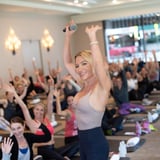
Image Source: Nick Gerber
The method behind the Tracy Anderson Method is a unique one: the temperature in her dance-cardio classes is cranked up to 86 degrees with 69 percent humidity, and Tracy provides zero instruction. Now, if you've ever taken a group fitness class, you're probably accustomed to motivational speeches in between sets or even military-style abuse. But the celebrity trainer, who's also Gwyneth Paltrow's longtime friend and business partner, simply tells you to move as she does as if you were playing a video game. I recently got a taste of Tracy's class (minus the heat) during the Chicago stop of G. Sport Sessions, a fitness experience by Westin Hotels and Goop, and I actually appreciated her silent style.
After 50 minutes of sweating it out on the mat, Tracy sat down for a Q&A where she explained the reasoning behind her class format:
"I speak with my body," she said. "The reason why I don't speak to you during the class is because I don't want to take from you. I don't want to distract you. I don't believe that I know how to move better in your body than you know how to move in your own."
She then went on to explain how she conducted her early research and the impact it's had on her method. She studied how different stimulus affected participants as they exercised by hooking them up to machines and allowing them to watch their favorite shows on TV as they walked on a treadmill. She continued to experiment and monitored the effects of different coaching methods, from motivational orders to bootcamp-style yelling, until finally, she landed on one that worked.
"Then I turned on music - the louder I turned on the music, the more neural pathways opened up," Tracy said. "Then I put my treadmill in front of their treadmills, and I shut up, and I turned up the music, and I said to mimic me. And their brains just opened up the craziest number of pathways by doing that."
She found that the key was to avoid stressful instruction and to allow class-takers to figure out the movement on their own rather than providing predictive cuing.
"It is not my responsibility to go, 'Shake it, girl, you got it!' or 'You're such a wimp!' It's terrible," she said. "How are you supposed to connect to your spiritual self during that? How are you supposed to process your emotions? How are you supposed to get to know yourself? How are you supposed to find yourself?"
As a result, you're more present and challenged. And honestly, I wouldn't mind if more instructors followed this way of teaching. Namaste.
Image Source: POPSUGAR Photography / Nicole Yi
Running Your First Marathon? A Running Coach Shares What to Expect

Running your first marathon is a very exciting and equally daunting experience. Training for and running 26.2 miles is not an easy task (we'll be rooting for you), but at the end of the day, you're going to feel like such a badass once you cross the finish line.
To ensure that you have the best experience possible during your training and race, we spoke to Roberto Mandje, an Olympic distance runner and coach of the New York Road Runners. Roberto shared his best tips, like dealing with race-day cramps, and the most efficient way to pace your race. Congratulations on your first marathon and good luck!
7 Brutal Truths We Wish Everyone Knew About Depression

The signs and struggles of depression are often harder to notice than those of physical conditions, but like any mental health disorder, it's just as debilitating without proper treatment and support. While it can be impossible to understand what someone with depression is experiencing, here are the most important things to know about depression, according to Allison Abrams at YourTango.
Depression is NOT a first-world problem.
Each year, 30,000 Americans die by suicide. In two thirds of these cases, depression is an underlying factor. In any given year, 6.7 percent of the adult population will experience a major depressive episode.
For those who are not part of the 6.7 percent, it's impossible to understand what someone with depression really goes through. Lack of awareness and education surrounding mental illness, and gross inaccuracies in the media inevitably result in misinformation.
Below, I hope to clarify some of the myths associated with depression, along with some examples of what NOT to say to someone who is depressed.
1. Depression is more than just sadness.
"Everyone feels this way sometimes."
False. Everyone experiences periods of sadness or grief during their lifetime, but not everyone will experience a clinical depressive episode.
A pervasive disease of the brain, depression goes beyond sadness, affecting every aspect of the sufferer's life. It can be a debilitating disease, and as a primary cause of suicide, a fatal one.
When someone is depressed, something as simple as taking a shower can seem like a Herculean task, as can any social interaction. Often one's view of themselves becomes so distorted they may see the world and everyone in it as an adversary, including family and friends.
They may know, intellectually, that they are loved and that the world is not 'against' them. However, intellect and reason play little role in depression.
What does play a major role are feelings of inexplicable guilt, helplessness and deep despair. Sometimes there may be sadness, and sometimes there may be no feeling at all- just a dull, paralyzing numbness, the idea of things ever getting better seeming like an impossibility.
2. Depression is NOT weakness.
"Snap out of it. It can't be that bad."
Depression has absolutely nothing to do with strength or character any more than cancer, or any other disease does. It is a combination of genetic, biological, environmental, and psychological factors that goes beyond mood.
Researchers have known for years that those with depression have a higher risk of heart disease and stroke, are more likely to die after a heart attack, and often have compromised immune systems, making them more vulnerable to infections and diseases.
If someone had a heart condition, you likely wouldn't say: "Just think positive to avoid that next brain aneurysm!" Saying "snap out of it" or any statement containing the word 'bootstraps', continues to further stigma, discrimination, and thus the prevalence of untreated depression.
Rule of thumb: If you wouldn't say it to someone with heart disease, don't say it to someone with a brain disease.
3. Depression is NOT a choice.
"But you're so young and pretty, what do you have to be depressed about?"
This was an actual statement made to a former client, by a psychiatrist who she finally agreed to see after years of self-harming and frequent suicidal thoughts, despite weekly therapy.
Telling her that she had 'nothing to be depressed about', or that physical appearance or age has any relevance whatsoever, implies that there is a choice involved, perpetuating the excessive feelings of guilt that often haunt those with depression.
Nobody chooses to be depressed.
When I hear of such insensitive remarks said to those brave enough to reach out, I almost understand why some are still hesitant to seek help. As mental health professionals, we can do better than that.
4. Depression is not a 'first world problem'.
According to the World Health Organization, 350 million people worldwide suffer from depression. That's 5 percent of the world's population, and 20-40 percent of women in developing countries experience postpartum depression, almost twice the percentage in industrialized countries!
The number of people to recognize and report symptoms or to be properly diagnosed by a mental health professional may vary among cultures, but who is actually at risk for developing a depressive disorder is not determined by nationality. Nor is it determined by appearance, race, age, socioeconomic status, religion, occupation, or education.
Depression doesn't discriminate. The idea that external circumstances are the sole contributor to the prevalence of a brain disease such as depression, discounts the genetic, biological and many other factors involved.
Rule of Thumb: Study the statistics before disseminating false information
5. Antidepressants do not 'turn you into a zombie'.
"My friend's sister's best friend's boyfriend's cousin knows someone who went on meds and they totally turned him into a zombie! They took away his personality!"
I hear variations of the above statement more often than I'd like, either from well-meaning friends and family of clients, or from clients themselves.
Like most medications, antidepressants come with the possibility of side effects and it may take a few trials to find the one that works with a person's unique body chemistry.
With advances in technology though, we have come a long way in developing new, effective medications, many with minimal side effects. Yes, there are other treatments out there and depression doesn't always require medication.
However, depending on the severity of symptoms, especially in the case of suicide, medication can be a lifesaver. So, before telling someone to go off of their 'meds', realize you're asking them to put their life at risk.
So, despite the fear-mongering, antidepressants do not "take away your personality"!
6. Antidepressants are not addictive.
"You'll get hooked on that stuff. Just try it the natural way."
Unlike some anti-anxiety medications or sleeping aids, antidepressants are not habit-forming. They do not result in craving when stopped, nor do they require an increase in dose to get the desired effect.
The withdrawal effects that can occur when someone suddenly stops taking the medication are the body's physiological response similar to a diabetic suddenly discontinuing insulin. This is why doctors recommend tapering off slowly rather than stopping altogether.
Are antidepressants and other medications over prescribed in our country? Yes. However, this does not negate all of the lives they have saved.
Not everyone who begins a medication regimen will need to continue long-term, but if it improves quality of life and reduces the risk of suicide, why not continue as long as needed?
Rule of thumb: If you don't have all of the facts, refrain from giving unsolicited advice.
7. Those who struggle with depression are not 'crazy.'
"These girls I date are crazy - they're all on meds!"
Any time I hear the words "crazy" and "meds" in a sentence, I cringe.
Considering the number of people who take some type of psychotropic medication, whether for depression, anxiety, ADHD or any other mental health condition, suggesting that every one of them is "crazy" is beyond ignorant.
More importantly, using the word 'crazy' at all to describe someone who struggles with a mental health condition is not only ignorant, but potentially very harmful. Here's an idea: let's remove the word "crazy", or any other disparaging term from our vernacular altogether.
Rule of thumb: If you wouldn't say it about your mother, your child or any of your loved ones, don't say it at all.
Above are just a few examples of the myths and inaccuracies regarding mental illness and depression in particular. So long as inferior medical benefits, systematic discrimination, lack of awareness and misinformation continue to exist, stigma will persist.
So, what can we do about it? By simply becoming more responsible with our language, learning the facts, educating ourselves and others, we are taking the steps necessary to change the way mental illness is viewed and treated in this country.
Again, remember that depression does not discriminate and can affect any one of us at any time, including those we love. It serves us all to know the facts so that stigma, and discrimination, become a thing of the past once and for all.
For more information on mental health awareness or to become an advocate, go to nami.org.
If you or someone you know is suicidal or in emotional distress, contact the National Suicide Prevention Lifeline: 1-800-SUICIDE (1-800-784-2433) or 1-800-273-TALK (1-800-273-8255)
Trained crisis workers are available to talk 24 hours a day, 7 days a week.
Allison Abrams is a licensed psychotherapist in private practice in NYC, and a mindfulness coach with the NY division of Leading Minds Executive Coaching.
Check out more great stories from YourTango:
I Worked Out Like a Kid and Burned Major Calories - Here's How You Can Do It Too

When my brother moved back home from college, he kept pushing me to work out with him. He's basically Andy Dwyer from Parks and Recreation IRL, but with twice the amount of energy, so sitting around watching Netflix as quality time wasn't going to work. However, I complained to him that exercising is so much harder as an adult. I played outside for hours every day as a kid, and I never imagined a day would come when I couldn't turn a cartwheel or race my bike up a steep hill. I had completely taken my strength and stamina for granted. Now, after years of sitting in a cubicle most of the day, I'd gotten soft. I had just started Kayla Itsines's Bikini Body Guide, and it calls for days of cardio throughout the week. I was not looking forward to it.
My brother and I reminisced about long Summer days as kids. When we were younger, there was no better feeling than having a hard-earned popsicle after playing really hard outside. Exhausted and panting, we'd animatedly strategize about what game to play next. We'd cool down for only a moment before racing back out into the sticky Southern heat. We never dreaded those hours of "cardio." It wasn't another box to check on a to-do list. It was just fun. I've noticed as an adult that walks with friends can easily turn into vent sessions, treadmills get monotonous, and solo cardio sessions can feel grueling. Maybe children are lighter because they make time for simply playing.
Being the master of simple solutions that he is, my brother suggested we just exercise like kids. And guess what? It worked. I look forward to our cardio sessions now, my anxiety has been way less intense, and my relationship with my brother has never been better. I feel happy. Here are some ways you can reconnect with your inner child and lose some of that adult stress (while also getting in a little outdoor cardio this Summer).
If it's climbable, climb it
The first thing I had to get over was being embarrassed. Kids don't even think about what adults think while they're playing - they just play. Good thing my brother has zero shame and has the energy of a golden retriever. We were walking around the local lake, and he just said, "Hey, bet you can't climb that." Next thing you know, we were scaling a huge boulder, trying to beat each other to the top. Then we jumped off and ran to find something else to climb.
Play a discreet (or not discreet) game of tag
This is going to look silly, but you have some options. Sure, you could play the traditional running way, but remember when you'd make up ridiculous rules to tag? Just tap back into that imagination. You could speed walk to be more low-key, or go even bigger. Jump, do high knees, skip. If it gets you moving and is still competitive, go for it!
Make a scavenger hunt
This can be as informal or formal as you want. I think it'd be really fun to do with a large group of friends with official rules, but my brother and I tend to keep it simple. We live in an area with tons of hiking spots, so we get off the trail to look for different animals, bugs, plants (or less-scientific stuff, like a person wearing a fanny pack or sweatbands), and I have to tell you, this has done more for my anxiety than anything else. There is a reason forest bathing is having a moment (that hopefully will never end). Spending time appreciating nature slowly is so good for the soul.
Play the "When you get to . . . " game
When you get to a trashcan, long-jump until the next tree. When you hit the next tree, sprint to the next boulder. At the boulder, crab-walk till you hit a mile marker. You get the idea. Make up some rules for your next walk, and if you mess up, you lose a life. Winner is first to the end of the trail, or whoever didn't lose all three lives (whichever comes first).
Play a little 1:1
Basketball, volleyball, soccer, flag football - whatever is in your area, do it. If you were a kid and passed a court, you'd probably stop and play. For some reason as adults, it seems we rarely do that. Next time, start a game. Before you know it, an hour will have gone by, and if you played hard, you'll have some major calorie burn to show for it.
This Equinox Trainer's Fat-Burning, Bodyweight HIIT Workout Only Takes 10 Minutes

Despite what you may have heard, you don't need to spend hours and hours at the gym to tone up, shed fat, and feel amazing. Martel Martellus, NASM-certified trainer at Equinox, recommends doing HIIT (high-intensity interval training) sessions when you're short on time and want to get in a good workout.
"HIIT workouts can help you burn a lot of calories in a short amount of time," Martel told POPSUGAR. "They also keep your metabolic rate high after your workout so you burn extra calories, even after." That means you'll burn more calories throughout the day, long after you've wrapped up your sweat session.
Not only does HIIT equal more calorie burn, but "it adds as a post-exercise appetite suppressant," Martel said. "It allows for higher levels of fat oxidation in the muscles, which basically means that your lipid molecules (fat cells) are broken down into smaller sizes and used for energy rather than excess storage, which contributes to weight loss." Sounds good to us. Where do we sign up?
I did a HIIT workout with Martel last week, and it was a tough one. We did seven different exercises for 20 seconds and rested for 10 seconds before moving onto the next one. You go through all the exercises once, rest for 60 seconds, and repeat two more times for a total of three rounds. That only equals 10.5 minutes of work. You can do anything for 10 minutes! And the best part is, you don't need any equipment for this session.
Here are the exercises, and descriptions for each one are below.
- Split lunge jump + squat
- Plyometric push-ups
- Mountain climbers + burpee tuck jump
- Shuffle + curtsy lunge
- Reverse burpee
- Lateral hops
- Split lunge jumps

 Articles


